Friday, November 20, 2009

Climate Change Adaptation

Excuse the lack of posts as of late. The semester is winding down and I have been nose-deep in climate change reports for my Environmental Management course.

Although this is school-related stuff, the material is progressive and noteworthy in a planning sense.

Adaptive capacity Indicators include:
  • economic resources
  • availablitiy of and access to technology
  • information
  • skills
  • degree of prepardness of infrastructure and institutions

Simply put, the more developed an area, the better they stand against the effects of climate change. These indicators differ in adaptive capacity based on subregions and sectors and the speed of reaction to these changes, as climate change can happen faster than our adaptation.

The multidisciplinary collection of experts behind the IPCC AR4 report point out that the role of institutions (ie. universities, government, etc.) is important in enhancing long-term adaptive capacity with the goal of making adaptation mainstream by including it in all forms of policy for planning processes. This must be informed by taking into consideration current vulnerabilities and future changes.

With that said, climate change is currently incorporated into long-term planning and decision making processes within conservation authorities (such as stormwater management) and public health departments (in the form of smog alerts). North America has historically been "reactive," to cope with these changes instead of being focused on preventative measures.

Using Global Circulation Models, coupled with several different emission scenarios, the IPCC researchers predict a future that will boast temperatures exceeding 30°C, with most of the warming happening in the winter season.
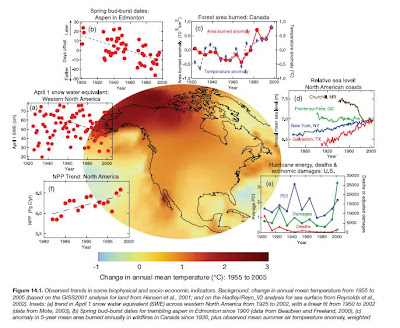

With ageing urban infrastructure found in all cities around the world, modifications required for adaptation involve retrofits to update and enhance how we live in urban centres.
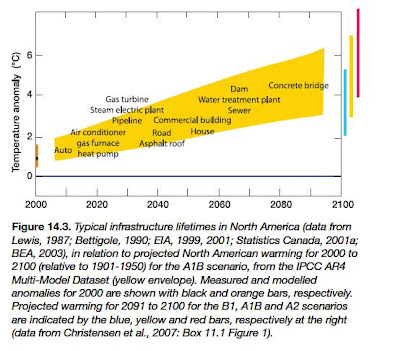

The implications carried through the various related reports recommend climate change be factored into all long-term plans as it is hailed as a reality by this Nobel Prize-winning intergovernmental panel of experts.

More literature on adapatation and Ontario municipalities can be found here.

Saturday, November 14, 2009

Vancouverism

Living Shangri-La is Vancouver's tallest building. Designed by James KM Cheng Architects Inc. (Photo by Uncle Buddha via Flickr)

I've seen this term being thrown around in various architecture readings, but never really knew what the term encompassed. Here is what I've learned:

"Vancouverism is characterized by tall, but widely separated, slender towers interspersed with low-rise buildings, public spaces, small parks and pedestrian-friendly streetscapes and facades to minimize the impact of a high density population."

Wedged between the sea, mountains and the US border, Vancouverism is truly a product of its environment.

Here is an interesting comparison between New York's modern architecture and Vancouver's neomodern styles and the policies that allow them to exist.

And if you didn't know before, you do now.

Wednesday, November 11, 2009

Hosang Park's 'A Square'


From Seoul, South Korea, Hosang Park's photographic series A Square articulates how public spaces blend in with urban living environments.

Friday, November 6, 2009

Blueprint America: Road to the Future


Featuring Denver, Portland and New York

This episode of PBS' documentary series
Blueprint America examines the United States' investment in its aging infrastructure and changes that are happening now by looking at several American cities and the systems they have created.

Watch here.

Toronto wins 2015 Pan Am Games


What are the Pan Am Games you ask? Well, it's known as somewhat of a prequalifier for the Olympics held every four years, the year before the big Games. Participants from the Americas and Caribbean compete in multi-sport events. With a history of losing two Olympic Games and two Commonwealth Games, this victory seems bittersweet.

(Courtesy of the CBC)

The Games will bring a $1 billion athletes' village in the West Donlands which includes a component of affordable housing after the games and develop sports infrastructure to the region in the form of a new aquatics centre with two 50-metre pools and a separate diving tank plus a high-performance sports training facility at the U of T's Scarborough campus. This will contribute to the health of our residents and to Toronto's identity as a city with world class facilities.

The Games will surely be good for tourism and potential public transit advances but will it cost us money or make us money?

Whatever happens post-2015, Toronto's vision of the future is grand.

Wednesday, November 4, 2009

PublicART: Eagles in the City

(Photo by LK Cavers)

When visiting Vancouver a few months back, it was hard not to notice the 7½ foot bald eagles taking over public spaces every several intersections (and in places you would least expect).

Modelled after other similar city art projects, 'Eagles In The City' intends:
  • To create an event that provides maximum exposure to sponsoring organizations, artists and the recipient charity
  • To invite tourists from around the world to visit our province and share in our culture
  • To produce an event that encourages the 'Arts', local businesses and individuals to come together in a spirit of community fundraising, benefiting the important work of the BC Lions Society's Easter Seal Services.
  • To generate artistic creativity and showcase BC artists
  • To celebrate the cultural diversity of our province and promote civic pride
  • To capture the imagination of children, adults, and tourists alike
  • To raise much needed funds to provide Easter Seal Services to children with disabilities
There seems to be a lot more done about showcasing homegrown artists and their projects in B.C. than there is here in Toronto. Correct me if I'm wrong... Perhaps I should ask the Buttercup girls.

More about this public art project can be found here. For more about Vancouver's Public Art Program proceed this way.

Dubai from the sky

Via Jeff Staple's blog. More photos here.

The tallest building in the world: Burj Dubai Tower